
Funding Punishment Over Care, and How Grassroots Organizing Fights Back
By Z Gorley
October 28, 2026
There is an Associated Press article from December 24, 2004, titled “Bitter Cold Claims Life Of A Homeless Man.” It is 44 words. The reader never learns the man’s name or age; only that he was treated for exposure and released from a hospital hours before dying, and that police believed the man was drinking.
In response to this tragedy, Teka Childress founded St. Louis Winter Outreach, a volunteer collective that prevents unhoused people from freezing to death. For nearly two decades, Winter Outreach was anchored out of MoKaBe’s. So when MoKaBe’s became the first business to condemn the South Grand Community Improvement District’s letter and encourage continued support of unhoused residents, they responded from experience.
Grassroots networks have long supplied year-round care for unhoused residents the city refuses to fund. In doing so, these groups not only cover city inaction; they’ve created blueprints for providing life-saving resources, leading directly to the proposed Code Blue legislation. But even with the best intentions, community care is far outmatched by a city whose default response to poverty is criminalization: policing, jailing, and prosecution.
Under Mayor Spencer’s drafted encampment plan, unless officials redirect significant resources to increase street outreach, shelters, and housing, the city will rely on the same violent playbook: using police and their accomplices (forestry, building enforcement, and code enforcement) to uproot the unhoused, discard their belongings, and issue tickets to people who have no money to pay fines and no address for a court summons. This approach is as ineffective as it is cruel, particularly as St. Louis City’s unhoused population increased by 75% since 2019, from 1,031 to 1,790 people.
If enacted, volunteer and grassroots networks will be left to triage, care for, and attempt to reverse human suffering perpetuated by what the city invests in most.
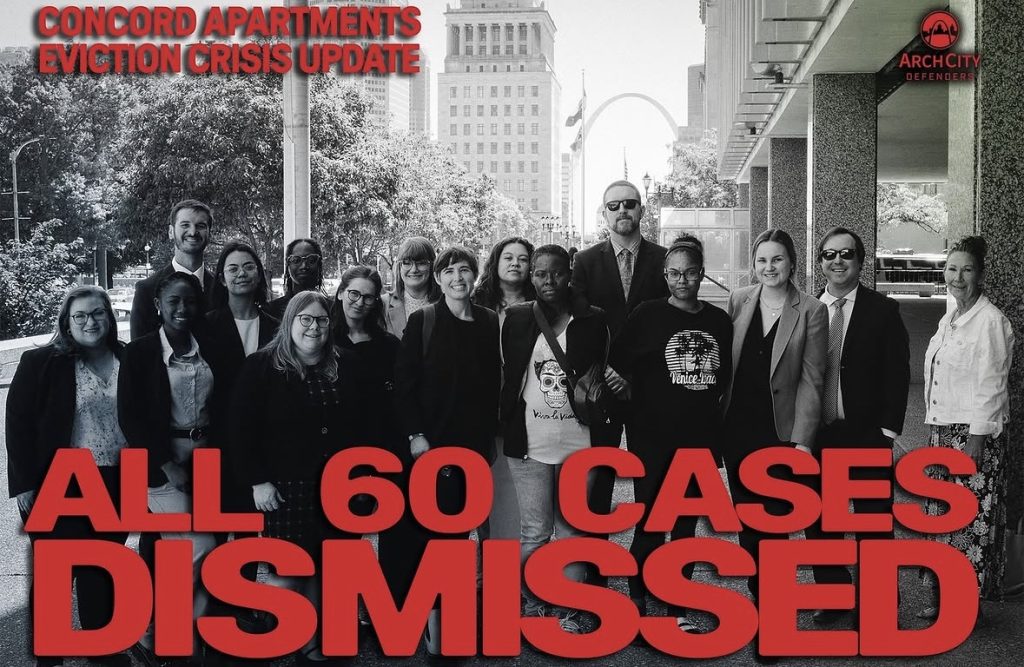
Look at what happened after the police raided Concord Apartments, home to elderly residents, working-poor families with children, and people displaced by the tornado. Not only did the city and police oust people from their homes; they boarded up their doors and windows, ticketed everyone they could, and prosecuted 60 people over an issue completely beyond their control.
The city provided no emergency shelter or resources, so we coordinated service providers and volunteers to link residents with support, even though options were limited. We also canvassed the area looking for former tenants facing municipal charges. While we could not locate everyone, our legal team represented 21 people, and the prosecutor agreed to dismiss all 60 cases. Yet, when people with nowhere to go set up tents nearby, the city threatened them with criminalization and removal all over again. To this day, we are not aware of the city providing any services or housing support to former tenants
One of the only times in the past decade that the city provided temporary shelter to people displaced by police was when a federal judge required it. In 2020, we filed an emergency lawsuit on behalf of a woman and several others who were forced out of their encampment across from City Hall. The lawsuit required the city to make on-the-record guarantees it repeatedly claimed were impossible, such as providing individual hotel rooms, transportation, COVID-19 testing, and a pledge not to arrest or cite residents. They found the resources, but it took federal litigation and public pressure to do the right thing.
So, what are we actually paying for? When elected officials continuously pour public funds into a police department and a jail that are each deeply scrutinized, severely lethal, and heavily litigated, it demonstrates a lack of courage and political will to invest in the basic resources that contribute to individual wellness and community safety: housing, healthcare, connection, accessible and sustainable income, and education.
When it comes to frustrated business owners, a condemned building, or an encampment, using police as the default response isn’t a surprise; it’s the direct outcome of choice.
This reality has galvanized a growing coalition of community members calling for the city to divest from harm and invest in life-saving resources. This spring, hundreds of people shared testimony urging unanimous support for three core resources: Code Blue winter outreach and shelter, Right to Counsel eviction defense, and the Office of Violence Prevention.
Rooted in human dignity and common sense, this coalition of St. Louisans expanded funding for these core resources from zero to millions of dollars. For the first time in history, the city allocated general operating funds directly to homeless services.
Securing investments in programs like Right to Counsel was significant. But to understand why that funding was so urgent, we turn next to the massive eviction machine operating in St. Louis.
This is Part One in a two part series. Stay tuned next week for Part Two: “Evictions and the Role of Media: How Displacement is Perpetuaed.”