
Evictions and the Role of Media: How Displacement is Perpetuated
By Z Gorley
November 2, 2026
The first column in this two-part series explored how St. Louis City’s budget actively funds the criminalization of poverty; but these budget choices do not operate in a vacuum. They coincide with a massive regional eviction machine and local media narratives that together reinforce displacement, a primary reason families continue to leave St. Louis.
The eviction machinery in St. Louis is designed for speed, scale, and destabilization. According to state court records, between 2017 and 2024, over 41,100 eviction cases were filed against renters in St. Louis City, and nearly 117,700 cases in St. Louis County. Cross-referenced with U.S. Census data, this means 50% of city renters and 60% of county renters faced an eviction in this short period.
Under Missouri law, evictions are fast-moving proceedings, averaging 30 days, with few protections for tenants. While 90% of landlords have legal representation, less than 3% of tenants do. A cluster of high-volume corporate owners and their attorneys drive these bulk eviction filings.
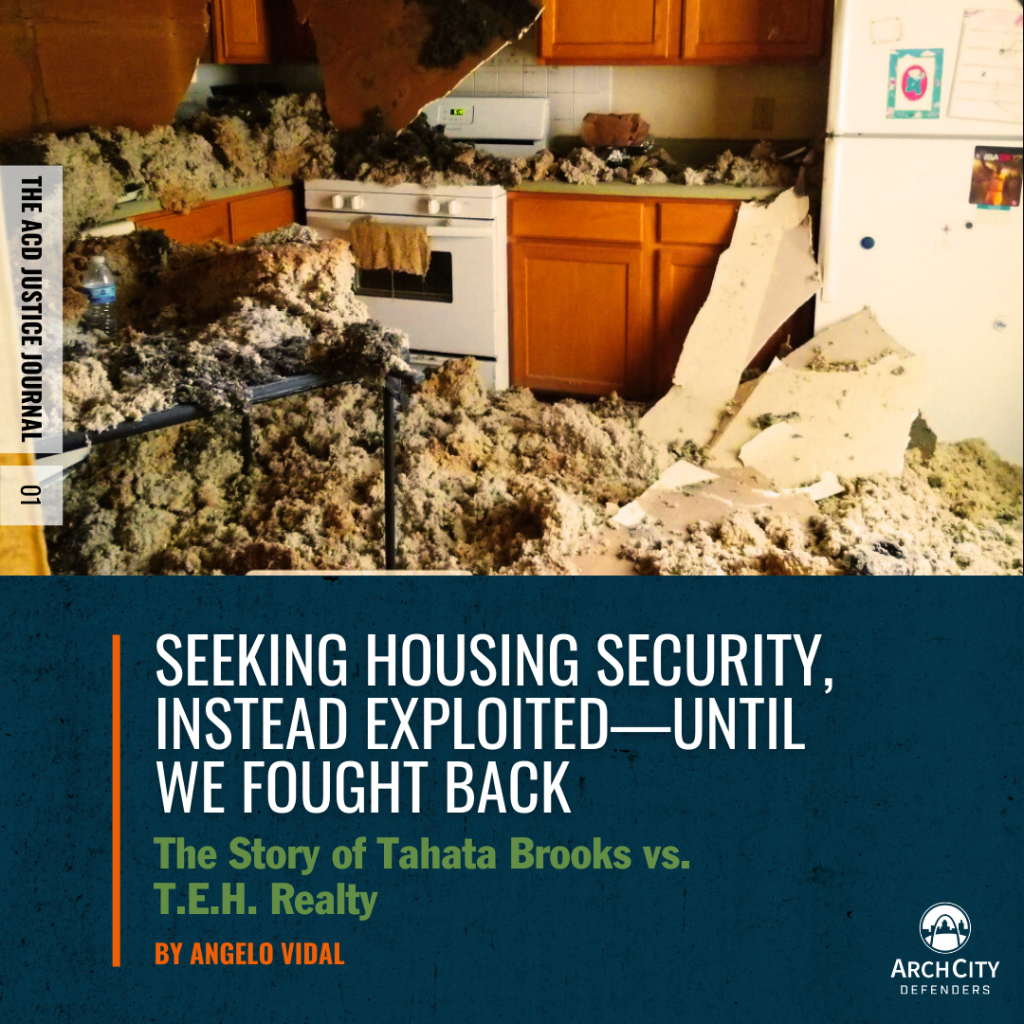
We have litigated against out-of-state corporations that purchase sizeable apartment complexes, run them into the ground, and hide behind shell companies. They ignore basic requests for repairs, charge excessive fees for late payments and online processing, and rush to file evictions simply to exert control—even when the landlord, not the tenant, is at fault. When this systematic neglect causes total structural decay, local government steps in not with aid, but with condemnations, as with Concord Apartments—pushing residents out with no recourse. Beyond the courtroom, families face the immediate violence of illegal lockouts: landlords changing locks, dumping personal belongings, and driving residents out without process. While many factors shape our housing crisis, the takeaway is fairly obvious: the best way to prevent homelessness is to ensure families have safe, affordable places to call home.
To counter this violence, ArchCity Defenders works alongside tenants on multiple fronts: defending families in court, helping clients secure housing, organizing for renter protections through our We the Tenants campaign with Action St. Louis, publishing pro se “know your rights” guides, and exposing abusive practices through legal action and media advocacy.
This holistic approach works. We address clients’ immediate legal needs, pursue affirmative litigation, and build platforms for impacted renters to tell their stories and shape policy. Since 2022, We the Tenants has mobilized grassroots support to pass Right to Counsel and establish an Impacted Tenants Fund for residents ousted by condemnations in the city. But winning a policy on paper does not guarantee funding or implementation. Over the past year, We the Tenants has sounded the alarm: without adequate resources and staffing, Right to Counsel remains severely underfunded and undermined.
This gap between policy and reality is critical as organizers push to codify permanent Code Blue shelter protections. While grassroots advocates demand shelter, the mayor’s office continues to default to criminalization—a strategy relying on sweeps while Missouri strips tens of thousands of residents of SNAP assistance. That default is precisely what the South Grand CID leaned on before public pressure led them to retract their letter. But outrage over a single letter isn’t enough, precisely because it was never an anomaly; it is part of a coordinated push to justify displacing people who have nowhere else to go.
The question becomes – when the default isn’t criminalization, what can we imagine instead? Beyond fully funding Right to Counsel and Code Blue, what becomes possible when we invest in care? And will local media cover it? This spring, when an unprecedented number of people collectively urged legislators to fund social infrastructure, not a single media outlet reported on it.
Legislators’ insistence on default responses, despite the obvious harms and public opposition to this approach, requires a third leg to stand on to stay intact: local media. When city departments set out to clear an encampment, media routinely plays a crucial role in manufacturing public consent.
In August, St. Louis Post-Dispatch coverage of the Pallet Yard encampment claimed the camp was “wearing on police,” a grotesque inversion that casts the city’s highest-funded agency as the victim of a housing crisis created by its own budget choices. Another piece asked if unhoused neighbors were “to blame” for surrounding crime. News outlets routinely scaffold a permission structure for state violence. Whether by framing stories through the perspectives of police, real estate, and property developers, parroting unverified statements, categorizing bulldozers and erasure “solutions,” or conflating area crime statistics to scapegoat encampments.
While headlines solicit fear, firsthand accounts from Pallet Yard residents reveal a starkly different reality: neighbors looking out for one another, finding missing people, and sharing resources. Sweeps and police line-items do not create safety; they manufacture displacement. From City Hall to the courtroom, St. Louis has spent decades funding the destruction of its own communities and then wondering why families leave. We cannot police or evict our way to a thriving city. True safety requires us to stop funding state violence and start investing in what keeps St. Louisans alive: housing, health, and care. When we choose care over criminalization, we build a city where every neighbor is known by name, and where our children have a future.